July 8, 2026
If you run a small business and landed here because of agents: start with The Business OS is not another SaaS or Anatomy of a follow-up system. This essay is the lab — how I operate.
At 8:30 in the morning, before I have decided what to do with the day, a briefing lands in Discord.
What moved overnight. What is scheduled. What looks stuck. What needs a human decision.
I did not write it.
An orchestrator agent called OWL did, after reading the state of the projects, the registries, the scheduled jobs, and the operating files that hold the company together.
Through the day, background jobs check whether the system is still alive. At night, another agent writes a synthesis of what actually happened and files it. Every Monday morning, a hygiene review audits the operation itself: stale files, dead processes, unclear ownership, duplicated context, jobs that stopped producing useful output.
The whole thing runs from a mini PC in my house in Corrientes, Argentina.
It started as one agent I set up in a day.
Three months later, it became thirteen.
That sounds like a story about agents. It is not, really.
It is a story about what has to exist around agents before they become useful.
The stack is less glamorous than the headline
The system has two layers.
The visible layer is the agent fleet.
Thirteen profiles, each with a role. Some talk to me through Discord. Some through Telegram. Some are scheduled workers. Some are specialists. OWL runs the internal operating workspace. A business lead agent coordinates work related to sales, content, research, websites, building, and marketing.
There are boundaries. OWL does not write sales reports. The business lead does not touch system plumbing. The system maintainer does not decide business priorities. That may sound bureaucratic for a one-person company. It is the opposite. Clear lanes are what let cheaper models do reliable work instead of expensive models doing confused work.
The second layer is less visible and more important.
Plain text in Git.
YAML registries. Markdown dashboards. Decision logs. Project files. Skills as versioned text. Weekly reviews. Inbox files. Generated reports.
The agents do not share a magical brain. They share documents.
Every project has a place. Every decision worth remembering gets written down. Every weekly review compares plan against reality. When positioning changes, the reasoning goes into a dated file. Months later, when 2am-me wants to reopen the debate, the file shows that 10am-me already did the thinking.
There is no project management SaaS at the center of this system.
The center is a set of files that say what is true.
What it actually does
Most agent demos are designed to impress a room.
This system is designed to remove categories of annoying work from my week.
It gives me a morning briefing. It captures ideas from Telegram. It files reports. It reconciles calendar reality against planned work. It monitors scheduled jobs. It checks whether long-running processes are still supposed to be alive. It keeps decisions from disappearing into chat history. It helps draft, inspect, summarize, and maintain.
The value is not that an agent can write a paragraph.
The value is that a whole set of operational loops now has memory, rhythm, and receipts.
I stopped writing many of my own reports. On Fridays, the system compares what I planned on Monday with what the calendar says actually happened. Some weeks the report is uncomfortable. Good. A report that only flatters the operator is dashboard theater.
I stopped losing ideas. Raw thoughts go into a Telegram bot. They are not organized instantly, because instant organization is where capture systems go to die. Capture is instant. Organization is scheduled. Monday has a triage ritual. The idea either enters the registry, becomes a task, gets parked, or gets deleted.
I stopped manually watching every background process. Processes register themselves with a time-to-live. If something outlives its purpose, or a scheduled job goes quiet, the system has to notice. Unwatched automation does not fail loudly. It fails silently, and you discover it weeks later when the business has already trusted a dead process.
That is the quiet value of the fleet.
Not magic. Less drift.
The intelligence is rented. The operation is owned.
I do not run local models for the main work.
The intelligence is rented from model APIs. The operation is owned locally.
The mini PC runs the gateways, schedules, files, memory services, workers, and glue around the models. Model choice works more like staffing than ideology. Careful models sit where judgment and writing quality matter: proposals, research, positioning, client-facing copy. Faster and cheaper models handle routine operations, sync jobs, classification, simple inspection, and high-volume tasks.
People often ask which model I use.
That is usually the wrong first question.
You do not hire a senior lawyer to stuff envelopes. You do not use the cheapest intern to negotiate the contract. The useful question is where judgment matters, where speed matters, where mistakes are recoverable, and where a human has to approve the result.
The agents reach the outside world through integrations: GitHub, Google Calendar, Google Drive, HubSpot, Slack, WhatsApp, Telegram, Discord, and other tools depending on the workflow. Some of that is handled through integration platforms. Some is custom. The principle is the same: agents should act through narrow, inspectable interfaces, not vague permission to “use the business.”
Memory is structured, not infinite.
Each agent does not need to remember everything. The sales agent needs pipeline memory. The research agent needs research context. The system maintainer needs infrastructure state. A project agent may need shared project memory. More memory is not automatically better. Bad memory is just stale context with confidence.
Skills are versioned. If an agent learns how to produce a better weekly report, that ability should become a file I can review, diff, improve, reuse, or give to another agent.
Prompts rot when they live only in chat.
Skills compound when they live in files.
The embarrassing part
Here is the part most people leave out when talking about agent fleets.
Several business agents were configured, assigned lanes, connected to gateways, and technically ready.
Then the status report showed the same line next to them for weeks:
No cron output registered. Waiting for brief.
The system was not waiting for intelligence.
It was waiting for direction.
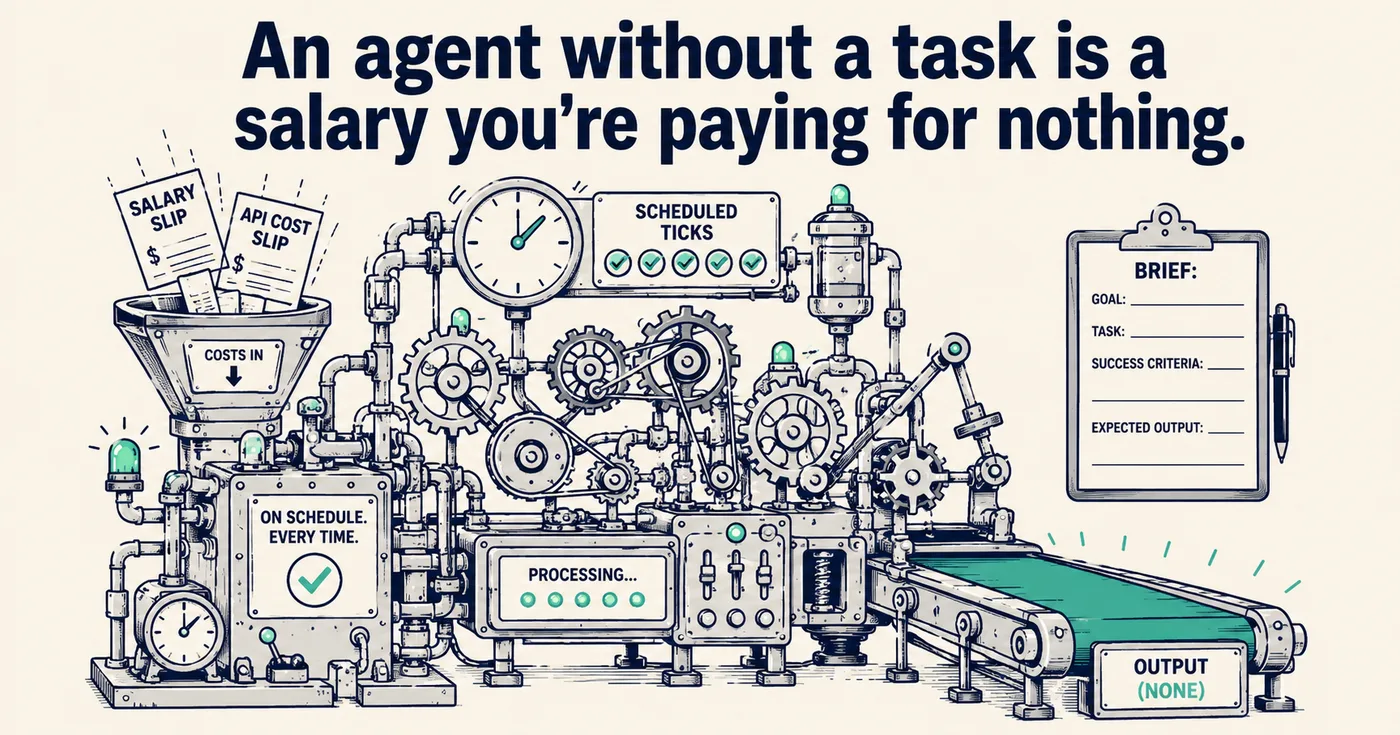
An agent without a task is a salary paid to an empty chair. A fleet does not generate its own business strategy. Someone still has to decide what market matters, what offer is worth selling, which client deserves attention, what work should be killed, and what “done” means this week.
That someone is the operator.
No orchestration layer removes that job.
In the same period where parts of the fleet sat idle, my own weekly review showed too much time going into improving the system and not enough time going into the company the system was supposed to serve.
The company was marked as critical in its own registry.
The system knew.
It was waiting for me.
That is the trap.
Infrastructure is the highest-status form of procrastination available to a technical founder. Sales calls can reject you. Orchestrators cannot. A better gateway feels productive. A cleaner registry feels responsible. A new agent feels like leverage. The machine always says yes.
But the machine multiplies whatever you feed it.
Feed it nothing, and it multiplies nothing beautifully, on schedule, with green checkmarks.
The rules that keep the system from becoming the business
A system like this needs constraints or it becomes a hobby wearing a company badge.
The rules I care about now are simple:
- Internal systems do not get a roadmap unless external work requires it.
- No new agent exists until the job has been done manually enough times to understand the pain.
- A system improvement has to produce an external action within seven days: a proposal sent, a client served, a follow-up completed, a report delivered, a page published.
- The scoreboard is external: revenue, proposals, replies, shipped work, client outcomes.
- System health metrics are diagnostics, not goals.
- If an automation only helps the automation system admire itself, freeze it.
The last rule matters most.
A bad system fails loudly. A mediocre system becomes furniture. A sophisticated internal system can become a private video game where the founder keeps leveling up the wrong character.
What I would build first if I were starting again
I would not start with thirteen agents.
I would start with four files and one useful worker.
First: a project registry.
Every active project, owner, status, priority, current next action, and last review date.
Second: a decision log.
Not just the conclusion. The reasoning. The alternatives rejected. The date. The assumptions. Future-you is not a reliable witness.
Third: a capture inbox.
A place where ideas can land without pretending they are already organized.
Fourth: a weekly review.
What was planned, what actually happened, what moved, what got stuck, what needs a decision, what changes next week.
Then I would add one agent.
Not a research agent because research sounds smart. Not a content agent because publishing feels productive. Not a sales agent before there is an offer.
One agent that reads those files and produces something externally useful: a follow-up list, a client-ready summary, a proposal draft, a weekly operating report, a publishing queue, a list of stuck opportunities.
If the first agent does not produce external value, the second one will not save you.
What the fleet really buys
The fleet does not make money by existing.
The files do not make money. The schedules do not make money. The dashboards do not make money. The agent names definitely do not make money.
What the system buys is operating leverage.
It gives me hours back. It catches drift. It keeps memory outside my head. It turns vague work into visible queues. It forces uncomfortable reviews. It makes repeated work easier to delegate. It allows a one-person operation to behave with more continuity than one tired person normally can.
That is valuable only if the recovered attention goes back into the outside world.
Clients. Offers. Follow-ups. Delivery. Writing. Sales. Relationships. Decisions.
A company run by agents is still run by the operator.
The better the agents get, the less excuse the operator has.
I build practical business systems for companies that need work to move reliably across tools, messages, people, and AI agents. If you are trying to build something like this inside a real operation, you can reach me through my contact page.
You can also email me at nicolasdominici@outlook.com or DM me on LinkedIn.