July 8, 2026
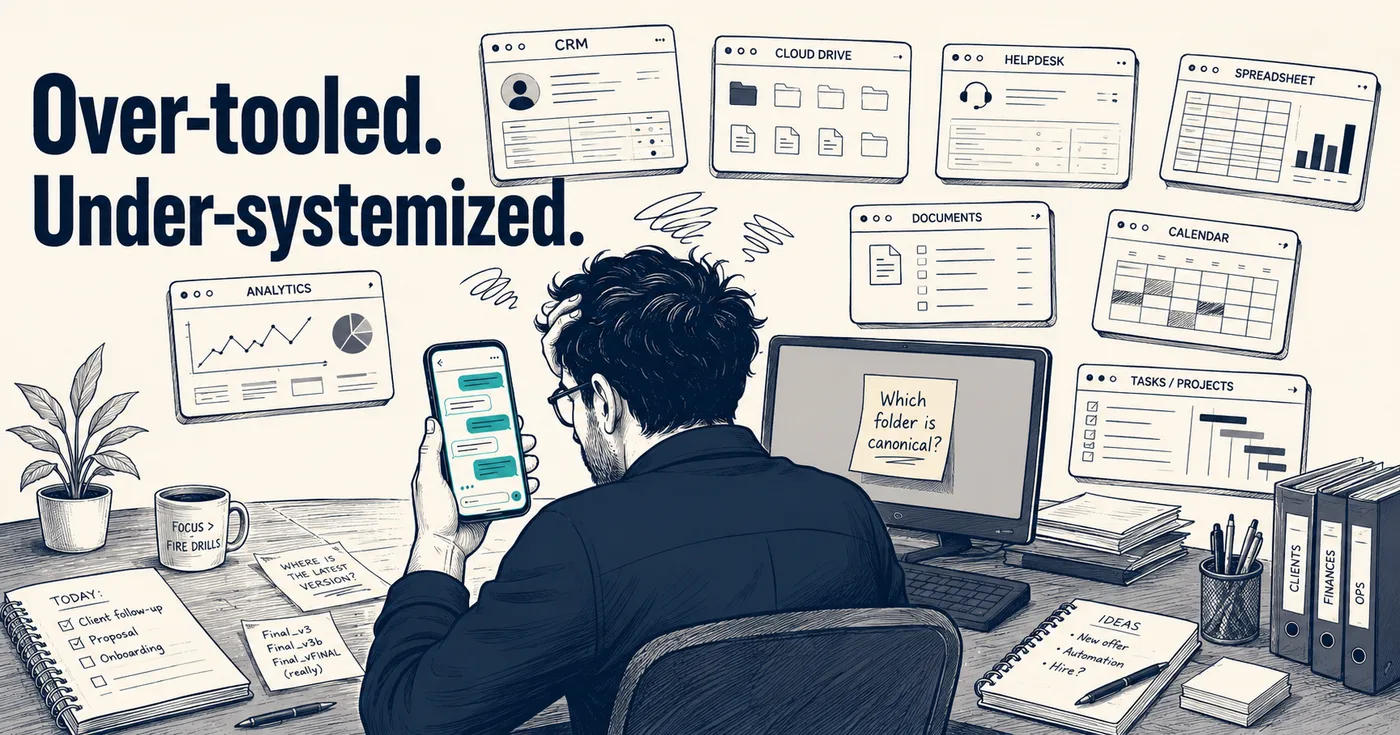
A lot of companies are not under-tooled.
They are over-tooled and under-systemized.
They have a CRM, but the real sales process happens in WhatsApp. They have Google Drive, but nobody knows which folder is canonical. They have dashboards, but decisions still happen in meetings with incomplete information. They have a helpdesk, but urgent requests bypass it through someone’s phone. They have spreadsheets that should have died two years ago but still run part of the business.
Then someone says the company needs AI.
Maybe it does.
But if the current operation is a pile of disconnected tools, adding AI creates a faster pile.
The missing layer is not another subscription.
The missing layer is an operating system for the business.
What I mean by Business OS
I do not mean a product category.
Not a dashboard. Not a CRM. Not an ERP. Not Notion with better icons. Not “AI agents” sprinkled over chaos.
A Business OS is the working layer that answers nine operational questions:
- Where does work enter?
- Who owns it?
- What state is it in?
- What should happen next?
- What context is required?
- What should be automated?
- What should be escalated?
- What should be measured?
- What should be reviewed?
A company can have many tools and still be unable to answer those questions.
That is the difference between having software and having an operating system.
Software stores pieces of the business.
A Business OS describes how work moves.
The old assumption was login first
Traditional SaaS assumes the user will go to the system.
Log in to enter the lead. Log in to update the deal. Log in to open the ticket. Log in to move the card. Log in to upload the document. Log in to check the dashboard. Log in to prove the work happened.
This works when the software is the center of the work.
In many companies, it is not.
Work happens in email, WhatsApp, calls, spreadsheets, meetings, voice notes, PDFs, screenshots, internal chats, and field updates sent at bad hours.
The system of record stays behind because the system of action is somewhere else.
CRMs die this way all the time. The business bought the tool. The humans kept working where the work was already happening.
The result is predictable: the CRM becomes a museum of outdated intentions.
The direction has to reverse
Old motion:
People enter the system.
New motion:
The system enters the flow of work.
A salesperson sends a voice note after a meeting, and the CRM gets updated.
A customer writes through WhatsApp, and the request is classified, routed, attached to the right record, and escalated if needed.
A manager forwards a supplier email, and the relevant fields enter the right workflow.
A technician closes a job from the field, and the invoice process starts without someone copying the same data three times.
An owner asks, “What changed this week?” and gets an operational answer, not a decorative chart.
This does not mean every business needs to become a chat interface.
That would be stupid.
Finance needs tables. Scheduling needs calendars. Inventory needs structured views. Permissions need control surfaces. Audits need logs. Analytics often need charts. High-risk actions need explicit confirmation.
Screens remain useful.
They just stop being the mandatory entry point for every operational action.
The components are boring on purpose
A useful Business OS has a few basic components.
Channels
Where work already happens: WhatsApp, email, Slack, Telegram, Discord, web forms, calls, internal tools, portals, and documents.
The channel is not the system. It is the edge where work enters.
Context
The current truth required to act: customers, opportunities, policies, documents, tasks, prior conversations, decisions, constraints, statuses, and ownership.
Without current context, agents and automations produce plausible garbage.
Workflows
Repeatable paths: intake, qualification, routing, follow-up, approval, fulfillment, reporting, escalation, review.
A workflow is not just “when X happens, do Y.” It is a loop with state, ownership, and consequences.
Agents
Role-based workers that interpret, draft, classify, summarize, escalate, inspect, and act inside boundaries.
Agents are not the Business OS. They are workers inside it.
Permissions
Who can read, write, send, update, approve, publish, refund, delete, escalate, or only suggest.
The more natural the interface becomes, the more serious permissions become.
Evals
Quality checks that keep the system honest.
Did the agent classify correctly? Did the report include the required fields? Did the response respect policy? Did the workflow escalate when confidence was low?
Memory
Operational memory, not infinite memory.
The system should remember what changes future behavior. Everything else can become noise.
Logs
Receipts.
What happened, when, why, by whom, under what rule, and with what result.
No logs, no trust.
None of these pieces is magic alone.
Together, they become the layer that lets a company operate with less friction.
Why AI features are not enough
Most AI features inside SaaS tools stay trapped inside the product’s worldview.
AI inside the CRM helps with CRM-shaped problems. AI inside the helpdesk helps with helpdesk-shaped problems. AI inside the document tool helps with document-shaped problems.
Real operations are cross-tool.
A lead enters from Instagram, gets answered on WhatsApp, becomes a call in Calendar, produces notes in a document, gets quoted from a spreadsheet, enters a CRM, receives follow-up by email, and disappears because nobody owned the next action.
No single SaaS product sees the whole path.
The Business OS should.
That is where the opportunity is: coordination between tools, not another AI panel inside one of them.
The boring test
A company has an operating system when it can answer basic questions without calling a meeting:
- What came in?
- Who owns it?
- What is stuck?
- What changed?
- What needs a human decision?
- What is the next action?
- What was promised?
- What is overdue?
- What should happen automatically?
- What should never happen automatically?
If the business cannot answer those questions, it does not have an operating system.
It has subscriptions.
Small companies need this earlier than they think
Enterprise software assumes process maturity.
Small and mid-sized businesses often do not have it. That is reality, not an insult.
The company grew because people were capable, responsive, and improvisational. That works until volume rises. The same informal habits that worked with 20 clients start breaking at 200.
“We need better software” often means:
We need the business to stop depending on memory, heroics, and chat archaeology.
The first version of a Business OS should be small.
One intake path.
One source of truth.
One follow-up loop.
One escalation rule.
One weekly review.
One report people actually read.
That is already more operational maturity than many companies have.
What companies really need from AI
The companies that get value from AI will not be the ones with the most AI features.
They will be the ones with the clearest operating model.
AI is useful when it can turn messy inputs into structured action: voice notes, emails, PDFs, customer messages, unstructured requests, long conversation histories, half-complete information.
But AI does not remove business logic.
The company still defines what matters, what gets promised, what gets escalated, what is allowed, what is measured, and what requires a human.
Flexible technology makes the operating model more important, not less.
The Business OS is connective tissue.
It turns tools into a system, messages into work, context into action, and automation into something the company can trust.
I build practical business systems for companies that have the tools but not the operating layer between them. If your work is scattered across CRM, WhatsApp, email, spreadsheets, documents, and people’s memory, contact me.
You can also email me at nicolasdominici@outlook.com or DM me on LinkedIn.