July 8, 2026
For a while, I described the work in the obvious way.
Automation. AI automation. Agents. Integrations. n8n workflows. Chatbots. CRM automation. Operational AI.
All technically true.
All the wrong frame.
Business owners do not wake up thinking:
I need an automation.
They wake up thinking:
Leads are slipping through the cracks.
Customers keep asking the same questions.
Nobody followed up.
My team is copying data between tools.
I do not know what happened this week.
The business depends too much on me.
The value is not the automation.
The value is the operational problem disappearing.
Automation is too small a unit
An automation is usually a connection between events.
When X happens, do Y.
When a form is submitted, create a row.
When an email arrives, classify it.
When a deal changes stage, notify someone.
When a file is uploaded, extract fields.
Useful.
Too small.
A company does not usually break because one task is not automated. It breaks because a whole loop is undefined.
Take sales follow-up.
The problem is not “send a reminder email automatically.”
The real questions are:
- Where do leads enter?
- Who qualifies them?
- What makes a lead worth pursuing?
- What happens after the first response?
- When does follow-up stop?
- Where are objections stored?
- Who sees stuck opportunities?
- What is the weekly review?
- Which numbers decide whether the system is working?
A workflow automates one movement.
A system defines the game.
Selling technical output puts you in the wrong category
When you sell automation, buyers compare you to tools.
Zapier. Make. n8n templates. A cheaper freelancer. A plugin. A chatbot subscription. A SaaS feature with “AI” on the pricing page.
That is a bad category.
The conversation drifts toward implementation cost instead of business value.
How many workflows? How many steps? How many integrations? How many hours? Can you do it cheaper?
Maybe the answer is yes. Someone can always build a cheaper workflow.
But the leverage is not in wiring tools together.
The leverage is understanding the business loop well enough to design a system that keeps producing the desired behavior after the first build.
Automation is part of that.
It is not the whole thing.
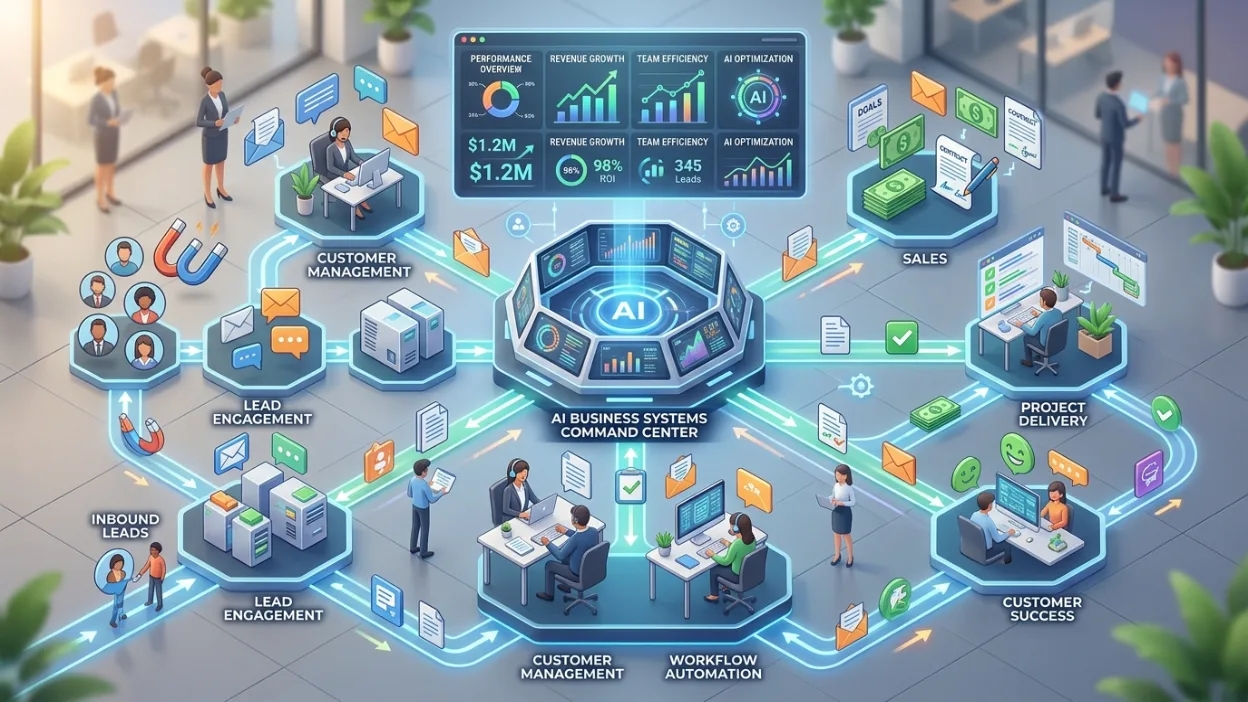
The better unit is a business system
I now think in business systems: repeatable operating modules tied to outcomes.
Not vague “digital transformation.”
Not fully custom software every time.
A system is a business behavior made reliable.
Examples:
Lead intake system
Captures inbound interest, enriches it, qualifies it, routes it, creates the record, and triggers the next action.
Follow-up system
Prevents opportunities from dying silently through cadence, ownership, reminders, visibility, and review.
Appointment system
Handles scheduling, confirmations, reminders, rescheduling, preparation instructions, and no-show recovery.
Support system
Classifies requests, checks context, answers common questions when allowed, routes exceptions, and keeps a record.
Document system
Extracts, validates, stores, and routes information from PDFs, forms, invoices, contracts, reports, and screenshots.
Reporting system
Turns operational activity into a weekly decision ritual instead of a dashboard nobody opens.
These are patterns.
The first implementation is the expensive learning loop. After that, the system should become configurable, reusable, and easier to deploy in similar companies.
Not rigid SaaS.
Not bespoke chaos.
Something in between.
The question changes
Selling automation, the question is:
What do you want automated?
Selling systems, the question is:
Where does the operation leak money, time, trust, or attention?
That question forces the buyer to talk about reality:
- missed leads;
- slow response times;
- repeated manual work;
- poor handoffs;
- lack of visibility;
- inconsistent service;
- work depending on one person;
- errors from copying data;
- decisions made without current information.
Once the leak is visible, automation becomes one tool among several.
Sometimes the solution is an agent.
Sometimes it is a workflow.
Sometimes it is a better intake form, a WhatsApp interface, CRM cleanup, a weekly operating report, a written policy, a standard message, or killing a step entirely.
Selling automation makes every problem look like a task.
Selling systems makes every problem look like a loop.
Why “custom project” is also the wrong frame
If every client gets a completely bespoke project, delivery becomes fragile.
Every implementation starts from zero. Every improvement stays trapped inside one client. Every bug is unique. Every sale creates new complexity. Every handoff depends on remembering how this one version was built.
That is not a serious way to build an operational systems practice.
The path is modular.
A system can be configurable without being generic:
- same intake logic, different fields;
- same follow-up engine, different cadence;
- same appointment workflow, different rules;
- same document extraction pipeline, different document types;
- same reporting layer, different KPIs;
- same agent architecture, different permissions.
The client gets a system adapted to their operation.
The builder gets compounding infrastructure.
That is where consulting and product thinking meet.
AI changes delivery, not business logic
AI makes these systems more powerful because it handles messy inputs.
Voice notes. Emails. PDFs. Customer messages. Unstructured requests. Long conversation histories. Half-complete information.
But AI does not remove the need for business logic.
An agent can classify an inbound request, but the company still defines what categories matter.
An agent can draft a response, but the company still needs policy for tone, promises, refunds, exceptions, and escalation.
An agent can update a CRM, but the company still decides which fields are meaningful.
An agent can summarize the week, but leadership still decides what numbers should change behavior.
Flexible technology makes the operating model more important, not less.
What I would not sell anymore
I would not sell “a chatbot.”
I would sell an intake and support system that happens to have a conversational interface.
I would not sell “CRM automation.”
I would sell a follow-up system that prevents opportunities from disappearing.
I would not sell “AI reporting.”
I would sell an operating review system that tells the owner what changed, what is stuck, and what requires a decision.
I would not sell “n8n workflows.”
I would sell business systems where n8n may or may not be part of the plumbing.
Words shape what the buyer thinks they are buying.
Sell plumbing and people negotiate pipe.
Sell water pressure and people understand the outcome.
What companies pay for
Automation is not the product.
The product is a business behavior that becomes reliable.
Leads get answered.
Follow-ups happen.
Documents get processed.
Customers get routed.
Appointments get confirmed.
Owners know what changed.
Teams stop copying the same data into five places.
The workflow is how the promise gets delivered.
It is not the promise.
I help companies design and implement business systems for sales, support, appointments, documents, reporting, and agent workflows. If your operation has leaks that another tool will not fix, contact me.
You can also email me at nicolasdominici@outlook.com or DM me on LinkedIn.